About Ammonium carbonate
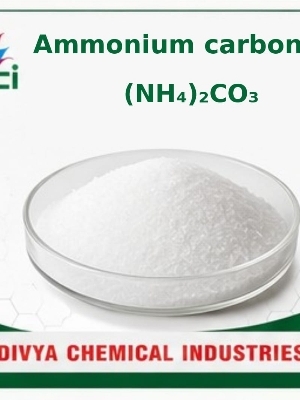
Ammonium Carbonate is a white, crystalline inorganic salt with a strong ammonia odor. It is readily soluble in water and decomposes upon heating, releasing ammonia and carbon dioxide. It is commonly used as a leavening agent, buffering agent, laboratory reagent, and in various industrial and chemical applications.
Product CharacteristicsAmmonium carbonate appears as a white crystalline powder with a sharp, strong odor noticeable even at low concentrations. With a density of 1.50 g/cm3 at 20C and a molecular weight of 96.09 g/mol, it is highly soluble in water. Notably, it decomposes at 58C, releasing ammonia and carbon dioxide, and does not melt or boil in the traditional sense. Chemically, the compound reacts with acids, and its solid nature means pH level is not directly applicable.
Safe Handling and StorageTo preserve longevity-typically between 12 and 24 months-ammonium carbonate should be stored in a cool, dry, and well-ventilated space with the container tightly closed. Users must wear gloves and eye protection and work in areas with proper ventilation due to the potential release of ammonia gas, which can be harmful by inhalation or ingestion. It is supplied in 25 kg HDPE bags with liners to avoid contamination and moisture ingress.
Applications and UsesThis chemical finds broad utility in food and pharmaceutical industries, especially in baking powders as a leavening agent and in smelling salts. Laboratories employ it as a reagent due to its predictable decomposition. Its solubility in water aids easy incorporation in a variety of formulations. The strong, recognizably ammonia odor also finds use in applications where a volatile base is required.
FAQ's of Ammonium carbonate:
Q: How should ammonium carbonate be safely handled and stored?
A: Ammonium carbonate should be handled with gloves and eye protection, ensuring use in a well-ventilated area. Store it in a tightly closed container in a cool, dry, and well-ventilated location to maximize shelf life and prevent exposure to moisture and air.
Q: What are the primary benefits of using ammonium carbonate?
A: Ammonium carbonate offers high purity and excellent solubility in water, making it ideal for use in baking, chemical leavening, pharmaceuticals, and as a laboratory reagent. Its reliable decomposition provides consistent results in leavening and analytical processes.
Q: When does ammonium carbonate decompose, and what gases are released?
A: Ammonium carbonate begins decomposing at 58C, releasing ammonia, carbon dioxide, and water vapor. This property is critical for baking and laboratory applications requiring the controlled release of gas.
Q: Where can ammonium carbonate be effectively applied?
A: This compound is extensively used in the food industry (as a component of baking powder), pharmaceutical formulations, smelling salts, and analytical laboratories as a chemical reagent. Its place of origin in this case is India.
Q: What precautions are necessary when using ammonium carbonate due to its toxicity?
A: Because ammonium carbonate can be harmful if inhaled or ingested, it is essential to wear protective gloves, eye protection, and ensure adequate ventilation during use. Immediate attention should be given to avoid direct inhalation of fumes due to its ammonia-like odor.
Q: How is ammonium carbonate packaged for distribution?
A: It is typically supplied in 25 kg HDPE bags with liners, protecting the compound from moisture, contaminants, and ensuring safe and efficient transportation and storage.

 Send Inquiry



 Send Inquiry


 Send Inquiry
 English
 Spanish
 French
 German
 Italian
 Chinese (Simplified)
 Japanese
 Korean
 Arabic
 Portuguese
